

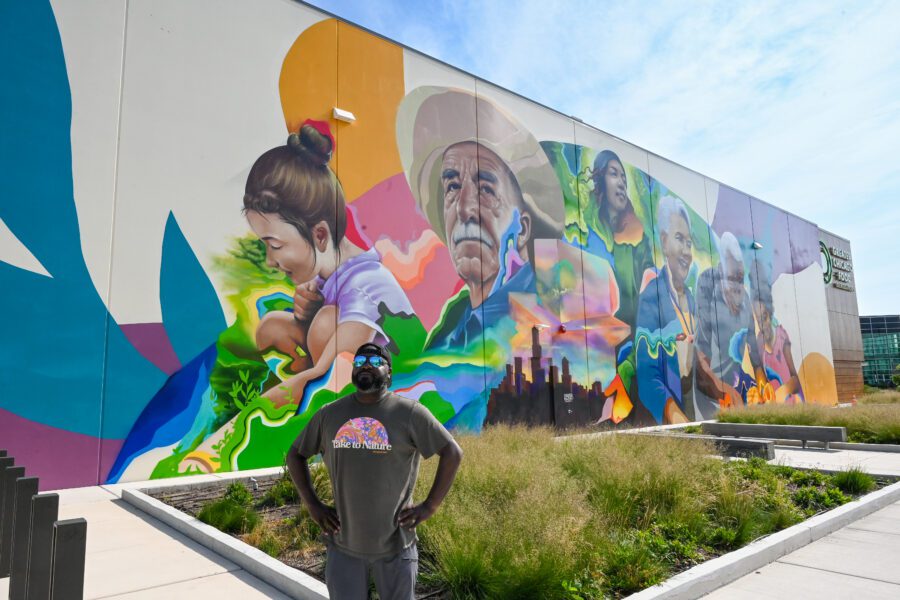
Max Sansing has been painting on walls in Chicago since he was 14. He started doing murals at 18, and by his late 20s he was designing and painting large-scale pieces of his own. In July 2026, after more than a month of work, Sansing finished the mural that now covers the front of the Food Depository.
It is the second mural to grace the building. Mario Mena, a muralist and teaching artist from Brighton Park, painted the wall first three years ago, and the Food Depository plans to invite a different local artist to create a new work on it every few years. Every artist starts with the same prompt: Chicago's community kitchens.
Sansing’s interpretation is one of vivid images and color. A young woman bends toward a garden. An elder in a wide-brimmed hat looks up past the roofline. A woman works among rows of greens, and a senior volunteer smiles over an armful of produce. At the far end of the wall a grandfather and granddaughter cook together. Bands of green, pink and blue move between the figures, and a black Chicago skyline rises from the bottom edge.
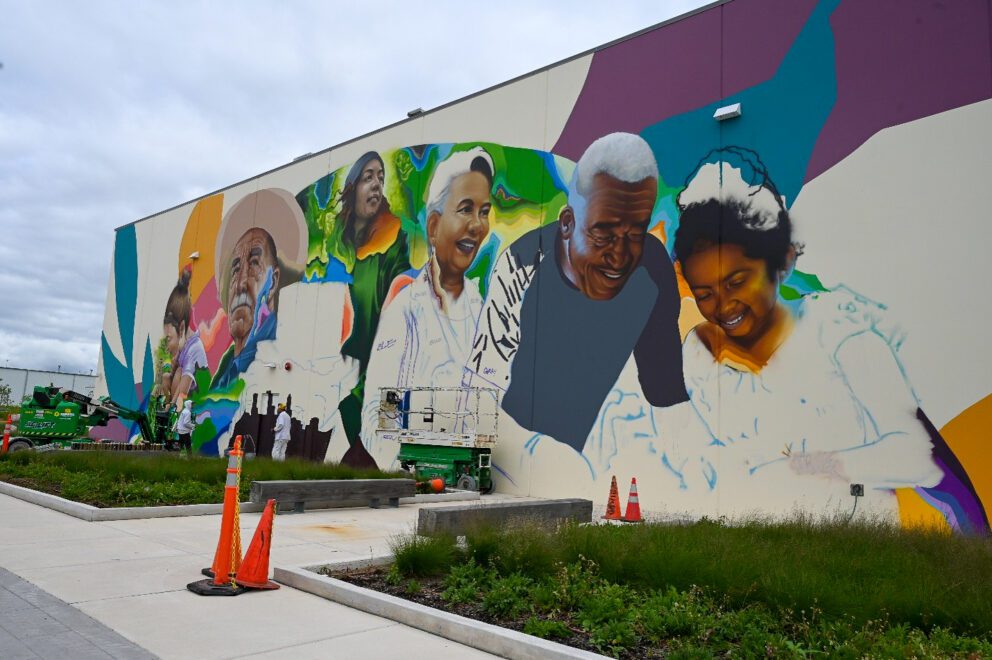
Max and his team work on the mural.
A half arch curves over the figures. "It's like this ‘under one roof’ idea," Sansing said. "I wanted it to invoke a spirit of this place for the people who do the work and the people that receive the work here, all the way from the workers to the volunteers to the community that they serve."
"I wanted each image to look like people who care about each other and people who care about what they're doing," he said. "And I hope that comes through in the piece."
Painting what he knows
Sansing was familiar with the Food Depository’s work throughout Cook County. "I've been impacted and the people I know have been impacted by the work that you all do here," he said. When the call came inviting him to paint our building, he said yes almost immediately.
Sansing grew up on the South Side, in neighborhoods where fresh, affordable food was hard to find, and he saw what the distance to healthy food did to the community. "I got to see the effects of kids being malnourished or just eating junk food and trying to pay attention in class," he said.
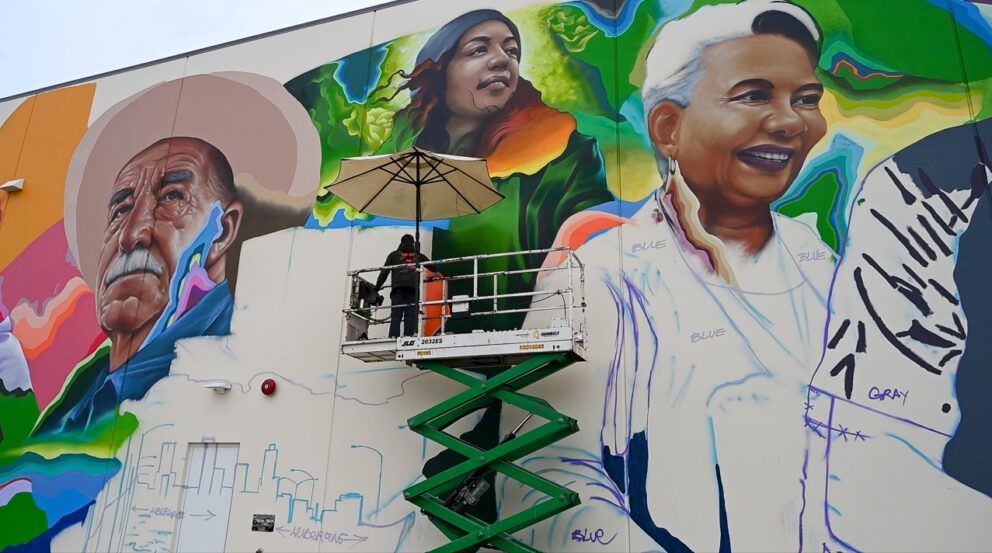
Max uses a lift to reach every inch of the mural.
That context is part of what made this project meaningful to Sansing. "These are the things that you are in this for, to be able to do something like this,” he said, gesturing to his mural, “for organizations like this."
No brushes
Sansing has a background in both graffiti and fine art, and the mural draws on both. He lays down base colors in latex, then sculpts forms out of them with aerosol. The portraits and every fine detail are spray paint. There is not a brush anywhere in the finished work. He plans the work, then leaves it room to move.
"A lot of it is control, and a lot of it is this stream of consciousness with the colors," he said. "I want the energy from me being out here to dictate the piece as well, and not always be something that I worked on in my studio."
Advice for young artists
Growing up, Sansing learned about the city by moving through it. He grew up thinking of his own neighborhood as the whole world, then joined Gallery 37 in high school. The city program paid teenagers to make art alongside professional artists at studios downtown and in neighborhoods across Chicago.

The final project was completed in July 2026.
"Getting a chance to go around and check out different neighborhoods was literally like going to different worlds, because they were so enriched with different cultures," he said.
Asked what he would tell young artists who want to work in public art, he didn't hedge. "If you're going to get into it, be brave and be unique and listen to your own voice. It's always good to see honest voices. Young, emerging artists, I look forward to seeing you out here."
Sansing's mural now covers the front of the Food Depository, where staff, volunteers and partners pass it every day. The faces on the wall are a reminder that ending hunger takes all of us. From the people who prepare and distribute food, to the neighbors who gather around it, we are all part of the movement to end hunger.
Share This Post