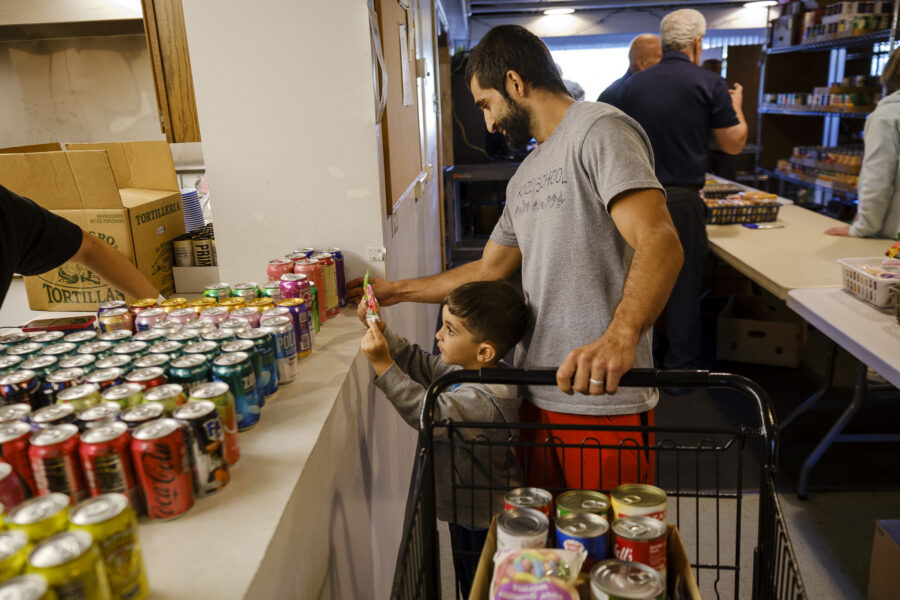
When Ahmad, 34, first walked through the doors of Elsie’s Pantry a few weeks ago with his 4-year-old son, Zid, he wasn’t sure what to expect. Taking in the shelves and tables of food, he was amazed.
“This is way more food than I thought I would get. I can’t even believe it. This is going to be so helpful,” he said.
Ahmad works as a ramp agent for an airline at Midway Airport, but a shoulder injury on the job has kept him from working for several months. His employer’s workers’ compensation payments supported his family for a time, but those payments recently ended. With Ahmad still unable to return to work and his wife at home caring for Zid, they have no income coming in.
Ahmad applied for the Supplemental Nutrition Assistance Program (SNAP) but has not yet learned if he will receive benefits. In the meantime, he sold the family’s second car and took out a loan to help pay their mortgage and other bills. He was also a week away from shoulder surgery. The trip to Elsie’s Pantry offered some much-needed breathing room.

Ahmad and his son, Zid, shop at Elsie’s Pantry for the first time. (Photos by Lou Foglia for the Greater Chicago Food Depository.)
“The quality of the food is really great. It’s stuff that we actually want and will use. We’re really grateful,” he said.
A growing need for food assistance
Ahmad’s experience reflects a larger affordability crisis facing Chicago households. The Food Depository’s 2026 Hunger in Chicago Report, conducted in partnership with NORC at the University of Chicago, found that 36 percent of Chicago households are food insecure.
Rising costs are a major reason why. Forty percent of Cook County households cannot afford the basic cost of living, and food prices in the Chicago metropolitan area have risen 22 percent since 2021.
Pantry coordinator Beth Heinrich, who helped found Elsie’s Pantry with her children 26 years ago, has watched those pressures build.

Elsie’s Pantry has been serving the southwest suburbs for 26 years.
The pantry got its start after a woman named Elsie passed away and left money to her church mission committee. The money was initially intended for a computer, but Elsie’s daughter wanted it to support something that would last. Heinrich suggested starting a food pantry to fill an unmet need in the community.
What began with a handful of parishioners has grown into a pantry serving 75 to 100 households each week. In partnership with the Food Depository, Elsie’s Pantry provides food to neighbors from Palos Hills and the surrounding southwest suburbs.

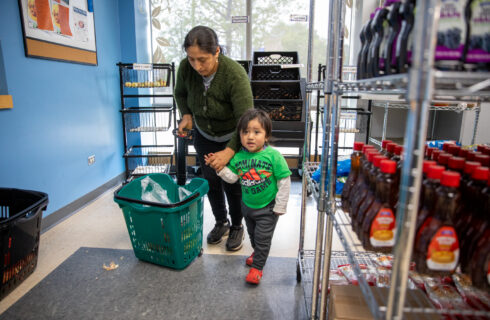
A pantry guest makes her way through Elsie's Pantry.
Heinrich has seen the number of people seeking help increase since federal SNAP cuts passed by Congress last year took effect. The law behind those cuts expanded work requirements and removed protections for groups such as veterans and older adults. More than 100,000 Illinoisans have lost SNAP benefits because of the expanded work requirements.
“People are just trying to make ends meet. You have your rent, your bills, your medicine, your gas, and then you have to figure out what’s left for food. We’re seeing more people who just need a little help getting through,” Heinrich said.
Stretching a household budget
Eunice Hall, 58, has been visiting Elsie’s Pantry for about six years. She works two part-time jobs, including one she has held for 20 years. Her husband works full-time. Even with both of them working, their income does not always go far enough. They are far from alone. The Hunger in Chicago Report found that more than half of food-insecure adults are employed.
Hall received SNAP benefits when she was younger and raising her two children. She remembers how helpful it was, but her income is now too high for her to qualify. She still has to make careful choices about where her money goes. “Everything helps,” Hall said. The food she gets at the pantry makes a big difference.

Eunice Hall is grateful for the food and the kindness she gets from the volunteers at Elsie’s Pantry.
“I try to come here first and get what I can get, then I go to the store and fill in what I wasn’t able to get,” she said. “Sometimes that’s still not enough or just barely enough.”
For Hall, the pantry is about more than groceries. “It’s a good place. It’s a safe, friendly place,” she said. “It’s wonderful how everyone has a real good, kind spirit,” Hall said.
When other costs leave less for food
Philip Scroppo, 60, recently started visiting Elsie’s Pantry. He lives alone in Palos Hills on a pension and has significant medical expenses after a kidney transplant.
“I come here because my medicines are thousands of dollars a month. It’s an impossible price to pay,” Scroppo said.

Philip Scroppo appreciates the quality of the food he receives from the pantry.
He pays for his medication with his pension, which leaves him with very little money for anything else. At the same time, his other costs keep rising. “Gas, water bill, rent, everything is high. The pension doesn’t go that far,” he said.
Food is one expense Scroppo can get help with at the pantry. “I really like the vegetables. Everything’s good. Everything’s fresh,” he said. “The people are so nice, it’s a nice place.”
For Ahmad, one unexpected setback made food harder to afford. For Hall and Scroppo, it's the steady pressure of stretching a paycheck or pension through the month. Elsie’s Pantry helps ease some of that pressure.
“People need food,” Heinrich said. “We do what we can to fill that need.”
Share This Post